
Admark Moyo
LLB, LLM, LLD
Senior Lecturer, Department of Private Law, Stellenbosch University
Bridget Joyce Machaka
LLB, LLM, LLD
Postdoctoral Research Fellow, Department of Private Law, Stellenbosch University
Volume 59 2026 pp 1 - 20
Download Article in PDF
SUMMARY
The legal and policy frameworks governing marriage in many African countries often presume gender neutrality, thereby failing to address the deeply gendered nature of child marriage and sexual exploitation and abuse. Data from UNICEF and other sources consistently show that child marriage disproportionately affects girls, with significantly fewer boys involved in the practice. Far from ensuring equal protection and benefit of the law, many existing legal provisions reinforce gender inequality by allowing exceptions to the minimum age of marriage or by setting a lower marriageable age for girls, thereby legitimising harmful practices against girls by virtue of these legal loopholes. Focusing on South Africa, the paper illustrates how current marriage laws violate girls’ rights to equal protection and freedom from sexual exploitation. For example, girls aged 15 or older may marry without ministerial or judicial consent, whereas all boys under 18 require such approval. This legal disparity leaves girls uniquely exposed and under-protected compared to their male peers, reinforcing patriarchal norms through discrimination entrenched in legislation. Adopting a feminist and intersectional lens, the article also explores how customary practices such as lobolo and ukuthwala continue to legitimise child marriage. These practices, when intersecting with gender-discriminatory laws, intensify the vulnerability of girls and exacerbate systemic abuse. The article critically examines international, African regional, and sub-regional child rights instruments to assess their gender sensitivity and responsiveness in protecting children, especially girls, from early and forced marriage. Finally, the article calls for urgent legal and policy reforms, including the removal of gender-discriminatory provisions and the implementation of substantive equality measures, alongside efforts to empower girls through legal, educational, and social interventions. These reforms must be accompanied by the dismantling of patriarchal structures and an acknowledgment of the diverse lived realities of girlhood, both essential to ending the systemic legitimisation of child marriage and achieving equal protection for all children.
1 Introduction
Child marriage robs girls of their childhood. It forces them to take on adult roles and responsibilities, curtails their educational opportunities and increases their health risks. Children should spend their childhood developing the skills and identities needed to transition into adulthood. Unfortunately, those who marry in childhood are not afforded the time, space or support to make this transition effectively.1
Despite global commitments to end child marriage, millions of girls across Africa, including South Africa, continue to be married off at a young age, often to significantly older men.2 According to United Nations Children’s Fund (UNICEF), nearly one in three girls in sub-Saharan Africa is married before the age of 18.3 Child marriage is not merely a cultural or religious practice; it constitutes a serious human rights violation that disproportionately affects girls, depriving them of their childhood, education, and economic empowerment.4 While often justified on cultural or religious grounds, child marriage functions in many cases as a socially sanctioned form of intergenerational sexual abuse, enabled by patriarchal norms and inadequate gender-sensitive legal frameworks. Child marriage is any formal marriage or informal union between a child under the age of 18 and an adult or another child. 5
Some legal frameworks often purport to be gender neutral but fail to acknowledge that boys and girls do not face equal risks. South Africa’s marriageable age minimums (MACMs) indirectly discriminate against girls by allowing them to marry from the age of 15 without ministerial or judicial consent, while requiring such approval for all boys under the age of 18.6 This gender-differentiated minimum age of marriage constitutes indirect discrimination and reflects deeply entrenched patriarchal assumptions about female maturity, sexuality and subordination.7 Without explicit protections for girls and young women, the principle of non-discrimination8 becomes hollow, enabling practices that commodify girls for the sexual gratification of older men. This, in turn, normalises the placement of girls in intergenerational marriages and legitimises abuse under the guise of matrimony. The article critically assesses the extent to which international, African regional, and sub-regional child rights instruments are genuinely gender-responsive in protecting children, particularly girls, from early and forced marriage. It discusses how patriarchal social and legal systems, including cultural practices such as lobolo and ukuthwala, contribute to the persistence of child marriage and intergenerational abuse. Through a feminist legal lens, this article calls for the harmonisation of MACMs and the removal of consent exceptions. It further advocates for a legal and policy framework that moves beyond formal equality to address the structural, cultural, and intersectional factors that heighten girls’ vulnerability to exploitation under the guise of tradition.
2 ‘Numbers do not lie’: Letting data and evidence speak
With nearly a third (32 percent) of its young women and girls being married before reaching the age of 18 years, East and Southern Africa is one of the regions with the highest prevalence and burden of child marriage globally.9 There are more than 50 million child brides (the number stands at 55 million if one adds child grooms) in the region, with the largest number found in Ethiopia, which is home to about 17.3 million child brides.10 While the prevalence of child (girl) marriage varies widely across the region, two (Mozambique and South Sudan) of the 10 countries with the highest prevalence in the world are located here.11 An estimated 4 percent of girls get married before they celebrate their 18th birthday in South Africa.12
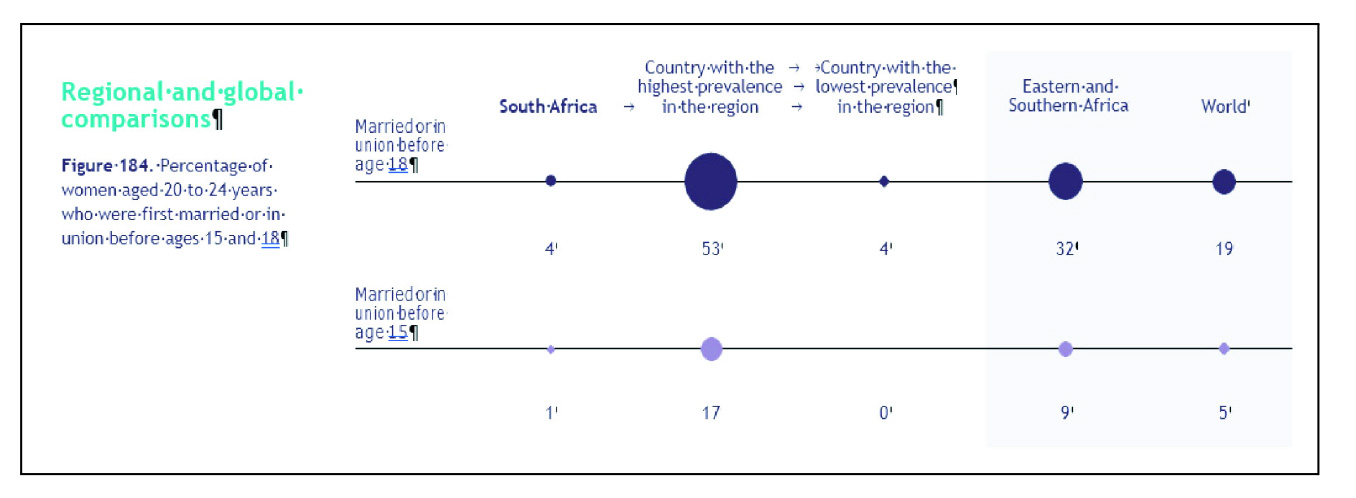
In addition, 207 children were married off in 2021, and in the absence of a harmonised legislative regime, harmful cultural practices driving the practice underground persist whilst pronounced under reporting (the exact figure could be astronomically higher than official data indicates) contributes to the problem.13 Disaggregating this number by age and type of marriage, 188 were brides and 19 were grooms while 37 were registered civil marriages and 19 were customary marriages.14 Official data gathered by UNICEF shows that five(5) percent of men were first married or in a union before turning 18 years in the region, with South Africa home to only one (1) percent of child marriages involving boys.15
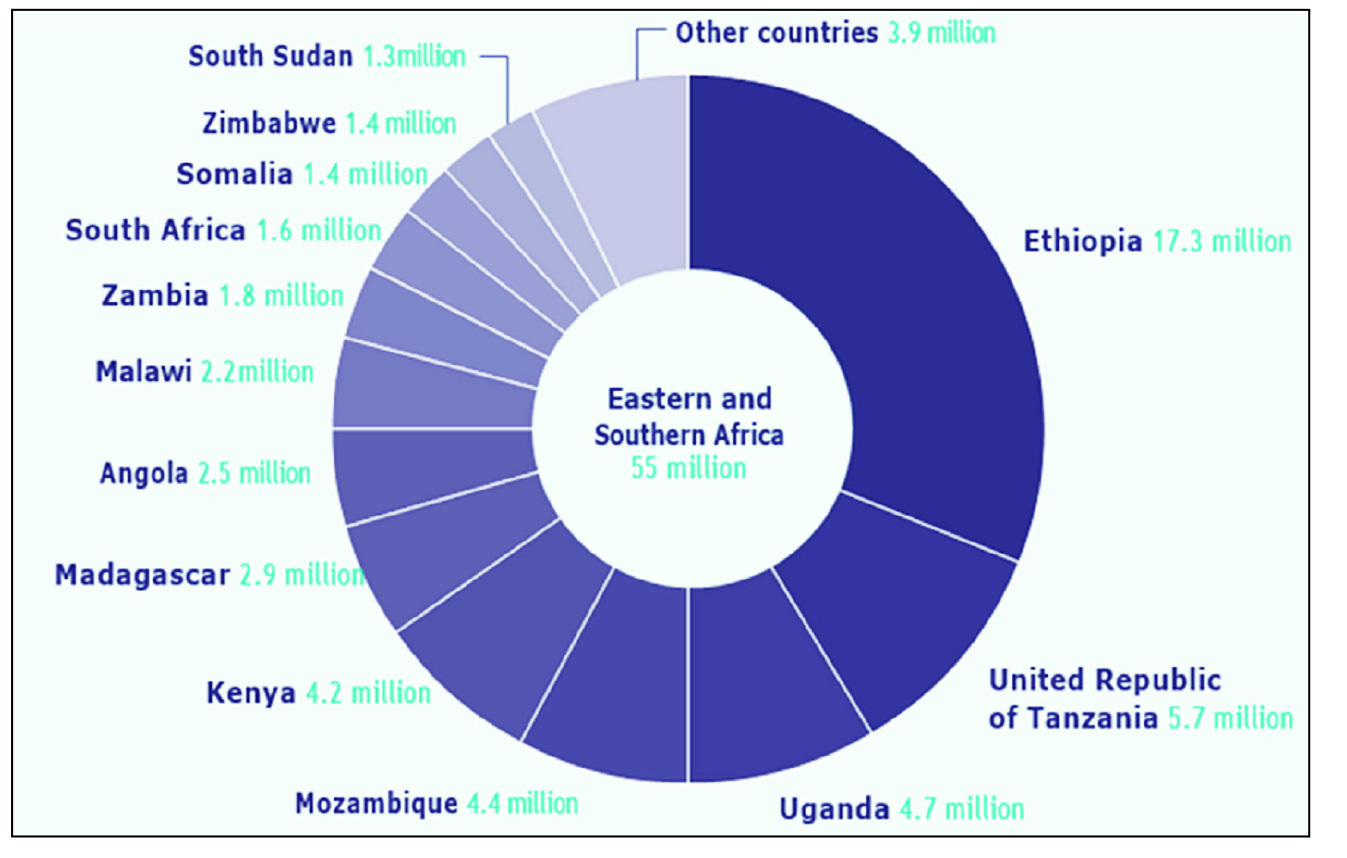

South Africa ‘boasts’ an estimated 1.6 million child brides, amounting to a ratio of one (1) in 28 girls getting married or stepping into a union before they attain majority status. 16 Perhaps more worrying are the percentages of married girls and young women who give birth before ages 18 and 20 years. The levels of early childbearing are reportedly high among married girls or young women, with 28 percent giving birth before age 18 years and 41 percent giving birth at or after age 18 but before age 20 years.17 It is also vital to consider the percentage distribution of ever-married girls or young women by timing of pregnancy and marriage. Evidence demonstrates that 15 percent of girls married before 18 years got pregnant before marriage; 20 percent got pregnant within the first year of marriage; 56 percent after the first year of marriage and nine (9) percent never gave birth.18 This confirms findings in other studies to the effect that child marriage is both a cause and a result of teenage pregnancy across the continent.19
As will be shown in subsequent sections,20 the findings referred to above suggest an interplay of both social factors that characterise childbearing as a natural result of marriage and cultural practices that construe the payment of lobolo or dowry as the purchase of the girl’s reproductive capacity. This reasoning is supported by one further statistic from UNICEF data; namely the percentage distribution of married women by the age gap between such women and their spouses. Twenty-eight (28) percent of the married girls or young women were 10 or more years younger than their partners; 20 percent were 5-9 years younger than their partners; 46 percent were 0-4 years younger and only 6 percent were older than their partners.21 Elsewhere, there is also abundant evidence indicating that the age imbalances between girls and men represent the linkages between poverty and early or forced marriage as families view marriage or the payment of dowry for young girls as a coping mechanism and poverty alleviation strategy.22 This is why there is a solid correlation between wealth quintile, access to education and child marriage, with out of school girls from poor families likely to marry way earlier than in-school girls from richer families.23
Over the years, regional and national progress has either stagnated or been too slow to turn the tide, with indications that ‘at the current rate, 20 million more girls in the region will marry in childhood in the next decade’, leaving the region off track in its attempt to achieve its SDG target of eliminating child marriage by 2030.24 Unsurprisingly, the national average annual rate of reduction of child (girl) marriage in South Africa has been 4.6 percent over the past 25 years and 6.7 percent over the last 10 years. As UNICEF projections indicate, these rates of reduction are below the required rate for elimination of child marriage by 2030, which stands at 9.1 percent for South Africa.25 To meet its constitutional, regional, and global commitments, South Africa must accelerate progress, particularly through gender-sensitive interventions aimed at keeping girls in school, delaying marriage, and dismantling harmful norms. These obligations include, among others, complying with the African Union’s legal and policy commitments to eliminate all harmful practices, including child marriage, by 2040 at the very latest.26
3 The legal and normative frameworks governing child marriage
3.1 International and regional instruments
International and regional human rights instruments increasingly conceptualise child marriage as a harmful, gendered practice that disproportionately affects girls. It is recognised as both a violation of children’s rights and a form of gender-based violence, underpinned by entrenched power imbalances and legitimised through legal and cultural norms.27 The Convention on the Rights of the Child (CRC) and the African Charter on the Rights and Welfare of the Child (ACRWC) enshrine the principle of non-discrimination,28 and basically impose obligations on States Parties to take all appropriate measures to ensure that girls are not disadvantaged in law or practice. Although the CRC does not explicitly mention child marriage, it sets out principles that are directly applicable, including the requirement that the best interests of the child be a primary consideration in all actions concerning children.29 It is difficult to reconcile this principle with any law or practice that allows a child under 18 to be legally married. Article 24(3) obliges States to abolish traditional practices prejudicial to the health of children, which has been widely interpreted to include child marriage.30 Notably, the Committee on the Rights of the Child (CRC Committee) and the Committee on the Elimination of Discrimination against Women explicitly recognise child marriage as a harmful practice and call for its elimination due to its disproportionate impact on girls.31
Similarly, Article 21 of the ACRWC obliges States Parties to eliminate harmful social and cultural practices, including those discriminatory to the child on the grounds of sex.32 Article 21(2) goes further by directly addressing child marriage in the following terms:
[c]hild marriage and the betrothal of girls and boys shall be prohibited and effective action including legislation, shall be taken to specify the minimum age of marriage to be 18 years and make registration of all marriages in an official registry compulsory.33
Article 21 is perhaps the most unequivocal provision34 which explicitly prescribes 18 years as the minimum age for marriage, leaving no room for exceptions based on religious or cultural norms, parental consent, or customary authority. It not only prohibits child marriage but mandates states to enact enforceable legislation to that effect.
The Protocol to the African Charter on Human and Peoples’ Rights on the Rights of Women in Africa (Maputo Protocol) specifically requires states to enact legislation that prohibits the marriage of girls under 18.35 It stresses the need for free and full consent to marriage - a principle that cannot be meaningfully applied to children. The Maputo Protocol further strengthens protections by recognising the interlinkages between child marriage, gender inequality, and sexual abuse. 36 It defines discrimination against women in expansive terms and obliges Member States to eliminate all forms of discrimination through legislative, institutional, and other measures.37 It codifies the duty of Member States to entrench in their laws and apply the principle of substantive equality between sexes.38 In addition, the Maputo Protocol obliges Member States to take corrective and proactive action where discrimination against girls continues to exist in law and in fact.39 To combat ‘legalised’ discrimination against girls, South Africa should adopt and/or support initiatives, at all levels, designed to eliminate all forms of discrimination against women and girls in all contexts.40
At the sub-regional level, Southern African Development Community (SADC) Member States are tasked with empowering women and eliminating gender-based discrimination through gender-responsive legislation, policies, programmes, and projects.41 This expansive obligation is entrenched alongside Member States’ duty to review, amend and/or repeal all laws that discriminate against any person on the ground of sex or gender by 2015.42 Furthermore, SADC’s Draft Protocol on Children’s Rights explicitly provides that ‘[a]ll children shall be protected from all forms of discrimination based on, among others, their ... sex’.43 Member States are further required to adopt specific measures to protect girls and promote their development, including by eliminating discrimination at all levels, within families, communities, institutions, and at the state level.44 These instruments demand gender-sensitive and child-responsive approaches that centre the girl child, protect her from sexual abuse disguised as marriage, and empower her through legal, social, and educational reforms.
Against this backdrop, the next section demonstrates that South Africa’s domestic legal framework continues to permit exceptions to the minimum marriageable age, thereby legitimising the intergenerational sexual abuse of girl children in blatant disregard of the country’s commitments under international and regional law.
3.2 South Africa as a delinquent Member State: Domestic legal exceptions to the MACM of 18 years
Minimum marriageable ages below 18 years constitute a form of gender-based discrimination against girls. The South African legal framework confers on minors limited capacity to marry under certain conditions, as outlined in various statutes. The Recognition of Customary Marriages Act (RoCMA)45 allows both boys and girls to enter into customary marriages with parental consent, without prescribing an absolute minimum age for such marriages. This omission creates a significant child protection gap.
The Marriage Act,46 also confers on minors under 18 the limited capacity to enter into a marriage with the consent of a holder of parental responsibilities and rights (who acts as a guardian of the child), the Children’s Court, and/or the Minister of Home Affairs, in certain circumstances.47 Section 24(1) of the Marriage Act requires marriage officers to refrain from solemnising a marriage involving minors unless the required consent is provided in writing.48 While this appears protective, it merely shifts decision making power to parents or guardians, who may be influenced by cultural expectations, poverty or gender-based discrimination, to consent to child marriage. Section 26(1) allows boys under the age of 18 and girls under 15 to marry if the Minister of Home Affairs deems the marriage ‘desirable’.49 This is an additional layer of consent that does not absolve minors from obtaining the consent of the holder of parental responsibility who acts as a guardian.50 The gender-based distinction in the prescription of a MACM is inherently discriminatory and conflicts with the constitutional guarantee of equality and non-discrimination.
South Africa’s half-hearted commitment to ending ‘child marriage’ is also evident from provisions regulating the validity of marriages entered into without meeting the necessary requirements. The Marriage Act provides that a marriage between persons of whom one or both are minors shall not be void merely because either the parent or guardian or the presiding officer of the Children’s Court, whose consent was required, did not consent to the marriage.51 Such a marriage may be dissolved by a competent court if a parent or guardian makes an application for dissolution before the minor attains majority or within six weeks of the parent or guardian becoming aware of the existence of the marriage; or if the minor makes an application for dissolution before they attain majority or within three months thereafter.52 Accordingly, the marriage is voidable, meaning it remains valid until it is set aside by a competent court.53
Unfortunately, even upon the application of the parent or guardian or minor, the Court is not bound to dissolve the marriage if it is of the view that the marriage is in the best interests of the child.54 Given the adverse impacts of child marriage on girls’ rights to education and development, health and life, it is difficult to imagine circumstances in which a ‘harmful practice’ should be deemed to be in the best interests of the child. Further, there are no guidelines for courts to make these determinations and there is no guarantee that correct calls will be made from one case to the other. In the final analysis, the ultimate decision on whether the girl should remain in the marriage depends on the subjective whims and pre-disposition of the judicial officer making it.
A MACM is meant to protect children from practices that undermine their right to life, survival and development.55 It establishes a presumption of incompetence for children aged below it. To codify an exception to the MACM is to re-open contentious discussions about the mental competence of children below the MACM on a matter that has been internationally labelled as a ‘harmful practice’ against children.56 It also allows the person entitled to give ‘substituted’ consent - whether the relevant Minister, government official, judicial officer, the parent or guardian - the liberty to disregard the MACM for subjective reasons or ends that are not in sync with girls’ core rights to survival, development, non-discrimination and best interests.57 It also raises questions about who determines whether a child is ready for marriage and what objective criteria is used in this determination. In practice, the determination of whether a child is deemed ‘ripe’ for marriage under such exceptions is entrusted to third parties exercising substituted consent, including parents or guardians, judicial officers, and, in some instances, executive authorities.58 South African law fails to prescribe clear, objective, and child-centred criteria to guide this determination. Instead, assessments often rely on subjective considerations such as perceived physical maturity, cultural norms, pregnancy, or familial and social pressures, all of which are indeterminate and inconsistent with internationally recognised children’s rights standards.59 Exceptions to the MACM expose children to intergenerational sexual abuse, rape and other forms of sexual violence in blatant violation of international law and should be outlawed.60 It is regrettable that South African law codify exceptions to the MACM; exposing girls to a practice that is deemed ‘harmful’ at international law and opens the floodgates for the abuse of parental, executive and judicial power, often to the detriment of girls.
4 Systematic gender-based discrimination against girls
There is consensus that the Marriage Act and the RoCMA have not amended the common law and, therefore, children below the age of puberty absolutely lack the capacity to consent to marriage.61 Therefore, girls aged between 12 and 18 years and boys aged between 14 and 18 years have limited capacity to enter into a marriage. They need the consent of parents or guardians, other holders of parental responsibility and, in some cases, ministerial or court-ordered consent.62 Initially arising from the common law, the gender-based distinction between boys and girls is open to constitutional challenge as the Constitution explicitly prohibits discrimination based on sex and gender.63
This distinction violates the equal-protection clause and constitutes direct discrimination based on sex and gender. Girls can get married from an earlier age than boys. Similarly, girls aged 15 years or older do not need ministerial consent to enter into marriage, thereby denying them the extra layer of legal protection afforded to all boys below the age of 18 years. This legal protection for boys is engrained in both a higher age of consent and the need for ministerial consent to all marriages involving boys under the age of 18 years. Generally, a person or group of persons is treated in a discriminatory manner if ‘they are subjected directly or indirectly to a condition, restriction or disability to which other people are not subjected; or other people are accorded directly or indirectly a privilege or advantage which they are not accorded’.64 It is clear that boys of all ages are directly accorded the legal protection (from the harmful impacts of child marriage) denied to all girls over the age of 15 years. This practice is one of the risk factors leading to teenage pregnancy, school dropouts and lack of education among girls across the continent.65
Under South African law, the establishment of discrimination based on a listed ground triggers the presumption of unfairness and shifts the onus to the state to justify the fairness of the impugned law or conduct by advancing sound reasons for such presumptively unfair discrimination.66 In such a case, the state needs to demonstrate that there is a rational connection between the differentiation of boys and girls, on the one hand, and a legitimate government purpose, on the other.67 Apart from codifying patriarchy, there appears to be no legitimate government purpose to be served by the explicit distinction in the protection of boys and girls. To ensure the equal, legal protection of all children from the harmful impacts of child marriage, South Africa should set the MACM at 18 years of age for boys and girls, without any exception.
The legislative exceptions outlined above constitute indirect and systemic gender-based discrimination. Indirect gender-based discrimi-nation against girls arises from the mere fact of having laws that permit children to marry. Whilst boys sometimes enter into marriages, this is not often the case. Across the African continent, girls are disproportionately affected by child marriage.68 Besides the alarming number of girls in marriages, the negative impacts of the practice are unevenly experienced by girls. To this end, the Centre for Human Rights has observed as follows:
Increasingly, child marriage is being viewed as a symptom of the profound gender inequality that exists in Africa. In one sense, it is a manifestation of gender inequality, which constitutes discrimination based on sex and gender. This is reflected by the overwhelmingly disproportionate prevalence of child marriage amongst girls. However, in another sense child marriage is a practice that reinforces gender inequality and the social constructions that entrench patriarchy and discrimination. Gender inequality lies at the root of child marriage and must therefore shape our perspectives and inform our approaches to ending it. 69
Unfair discrimination manifests when a burden is imposed on persons who have been historically subjected to systematic patterns of discrimination, including women and girls.70 Arguably, a seemingly neutral law or policy that allows children over the age of puberty to marry with or without parental consent, mainly denies girls equal protection and benefit of the law.71 Scientific evidence and literature demonstrate that the overwhelming majority of ‘married’ children are indigent and vulnerable girls, often without an education, from poor families and neighbourhoods.72 Gender discriminatory exceptions to the MACM allow parents or guardians to marry off young girls before they become physically, emotionally and psychologically mature. In addition, gender-based differences in MACMs violate provisions of international human rights instruments guaranteeing equality.73 Provisions with different marriageable ages for boys and girls assume incorrectly that the latter have a different rate of intellectual development from the former, a silent claim not backed by any scientific evidence.74
Accordingly, the pronounced vulnerabilities of girls to marriage in South Africa cannot be addressed by simply conferring full legal capacity on all children above a specific age. Such an approach maintains the status quo and adversely affects girls’ chances to learn, develop, thrive and flourish. The Constitution prohibits unfair discrimination directly or indirectly based on gender and other grounds and requires national legislation to prohibit it.75 Complemented by other pieces of legislation meant to combat gender-based discrimination,76 these provisions require the government to outlaw child marriage and to equally protect all children. To this end, raising the MACM to 18 years across different types of marriages and sexes, and prohibiting all exceptions to the ‘universal’ MACM under any circumstances, goes a long way in outlawing child marriage and protecting girls from its harmful impacts.77
5 Harmful cultural practices driving child marriages: A violation of international norms
As a Member State to international and regional child rights instruments, South Africa is bound to prohibit all harmful practices, including child marriage. Harmful practices that promote child marriages, reinforce gender discrimination and intergenerational abuse stem from patriarchal beliefs, cultural practices such as lobolo and ukuthwala. These are often framed as manifestations of cultural and religious rights and freedoms.78
5.1 Patriarchy and child marriage in (South) Africa
Patriarchy, in its classical sense, refers to the rule of the father or the ‘patriarch’. The term ‘patriarchy’ is broadly used ‘to refer to male domination, to the power relationships by which men dominate women, and to characterise a system whereby women are kept subordinate in a number of ways’.79 It is the domination of the masculine gender over their feminine counterparts regardless of or in collusion with class or economic status, race, ethnic origin, age and other markers of disadvantage.80 This system of patriarchy remains a defining characteristic of many traditional African societies, where gendered social norms and hierarchies continue to suppress women's and girls’ agency. These societies often stratify roles based on sex and gender, imposing arbitrary limitations on the public and private participation of women and girls, thereby reinforcing structural inequality.81
Despite global progress in challenging patriarchy and promoting gender equality, many societies still view women and girls from the prism of commodity of use, mere objects to be used by men to achieve the latter’s own ends.82 The objectification of women and girls ‘reduces them to objects of sexual pleasure and gratification’,83 often with far reaching adverse impacts on their education, health, mental well-being and agency. As such, they are largely seen, used and manipulated, often portrayed as purchasable ‘tools’ owned by other persons.84 This disregards their thoughts, experiences, and autonomy. It entails treating women and girls as mere instruments for achieving other people’s purposes, thereby denying them their subjectivity and autonomy, and portraying them as inert and violable. 85
For purposes of understanding the linkages between patriarchy, culture and child marriage, it is imperative to note that patriarchy ‘refers to kinship systems in which men exchange women’ and as ‘a system of social structures and practices in which men dominate, oppress and exploit women’.86 Child marriage reflects male domination and entrenches unequal power dynamics.87 Apart from labelling ‘the law’ as a largely masculine and gender-biased instrument designed to advance the patriarchal interests of men, feminist legal theory challenges the perceived natural superiority of men and boys over women and girls.88 It seeks to reverse the social configuration of women as a subordinate class and the application of arbitrary gender-based legal rules that objectify women and girls, including in the context of (forced) marriage.89 Given that young girls neither fully understand the risks and benefits of marriage nor possess the mental capacity to choose their life partners, it is arguable that ‘they are forcibly given away in objectification not minding their psychological, physical and social preparedness’.90 As such, these patriarchal practices enhance gender discrimination by normalising the early marriage of girls, often below the legally prescribed MACM, thereby stripping them of autonomy and reinforcing intergenerational cycles of abuse and inequality. Such practices violate international and regional legal standards which obligate States to eradicate harmful cultural norms that infringe upon the rights, dignity, and evolving capacities of the child.
5.2 A word about lobolo (dowry)
Apart from promoting child marriage, the payment of lobolo largely commodifies girls and perpetuates their abuse and exploitation in cross-generational relationships.91 Even after 30 years of valuable lessons on democratic values and individual rights since the fall of apartheid, it is taboo in South Africa for a woman to get married without their father receiving ‘lobolo’ payment.92 Invariably, the lobolo payment is given to the bride’s family by the groom’s family, but the girl or woman does not participate in the decision-making process, gets nothing from the proceeds of ‘her own sale’, and possesses no agency to suggest the value of the money or items to be received during lobolo negotiations.93 While lobolo can be viewed as a legitimate cultural practice, ‘it is seemingly equivalent to a business deal of buying and selling young women while young men do not get sold’.94
Unsurprisingly, socio-economic factors such as poverty have not only changed the original rationale behind the payment of lobolo, but also turned young girls into marketable commodities or objects that are easily ‘sold’ to older males who have the resources needed to rescue families out of poverty.95 For indigent parents, marrying off young girls (who often attract high bride wealth) relieves them of the financial duty to provide and educate them.96 Largely construed as an economic empowerment strategy for families in many African countries,97 lobolo perpetuates gender inequality and the object status of girls,98 making it difficult for authorities to combat the practice through ordinary law enforcement mechanisms. Poverty fuels child (‘girl’) marriage as parents seek to charge or are offered high amounts of lobolo in exchange for forcing young girls into early marriages.99 These practices take place in cultures anchored on male domination and the object status of women and girls in clear contravention of gender parity norms entrenched in international and regional norms.
5.3 Ukuthwala: Customary abuse of the girl child
In South Africa, child marriage is partly driven by a polluted version of ukuthwala, a cultural practice in terms of which a man mock-abducts a girl or young woman to his home with the intention to marry her.100 In its original version, ukuthwala was designed to enable persons of similar ages who were in voluntary relationships to trigger marriage negotiations between the their families.101 However, there is growing evidence that adulterated versions of ukuthwala have been used to justify the abduction, rape and forced marriage of girls.102 These actions blatantly violate the right to dignity; bodily and psychological integrity; and freedom from sexual violence, exploitation and abuse as protected by international and domestic law.103 Given that ukuthwala is now frequently relied upon to drive and defend extremely questionable cross-generational unions between young girls and older men, it is becoming difficult to rationalise the practice, even based on one’s right to culture, freedom of conscience and religion.104 Where the girl or her family is unaware of the man’s plan to ‘thwala’ her, but he achieves his goal by using force, threatens to rape her and to coerce her into a marriage, there is no doubt that such actions contravene both marriage and sexual consent laws in South Africa.105 Coercive ukuthwala should be viewed as a form of gender-based violence. It unjustifiably infringes on a broad spectrum of rights, including the right to education, freedom from violence and freedom of choice. 106
In R v Jezile, 107 the Western Cape High Court was tasked to determine whether the accused, who abducted and raped a 14-year-old girl under the guise of ukuthwala, could rely on culture as a defence to criminal charges.108 The court rejected this defence, holding that the girl had not consented and her constitutional rights had been violated. The accused was convicted of rape and human trafficking and sentenced to 22 years’ imprisonment.109 The case reflects how cultural norms enable male advantage and girl child exploitation. The case also highlights the entrenched ‘commodity status’ of girls and the multiple, intersecting vulnerabilities that drive both child marriage and intergenerational sexual abuse of girls within families and communities.
The South African Law Reform Commission (SALRC) has emphasised that given the individualistic nature of the rights protected in section 28 of the Constitution, ‘the right of an individual child supersedes that of [the] cultural or religious group’.110 Similarly, in its Concluding Observations on South Africa, the Committee on the Rights of the Child (CRC Committee) reiterated its ‘concern[s] about the harmful practices carried out on children in the State Party, including the abduction of girls for the purpose of forced marriage (ukuthwala), child and forced marriage’.111
Legally, however, it is hard to argue against ukuthwala for various reasons. This is due in part to the absence of a harmonised MACM for both sexes and the fact that existing legislation still permit child marriage in various instances. Moreover, the existing laws governing marriage are often inapplicable to ukuthwala, even where underage marriage is otherwise legally prohibited. While passing laws that prohibit ukuthwala-based forced marriages is an important step in the right direction, such laws alone cannot end sexual abuse of girls in cross-generational relationships.112 An effective remedy requires a holistic and more nuanced approach, one that addresses varying versions of the practice; and supports caregivers and communities in reforming underlying harmful social and cultural gender norms that sustain ukuthwala. This include the deconstruction of rigid notions of masculinity, femininity and deeply entrenched gender inequality that are reproduced through the institution of girl marriage.113
South Africa should intensify the investigation and prosecution of ukuthwala cases. It should also adopt legislation that defines and criminalises all forms of child and forced marriages under all circumstances. In addition, the State should review and, where necessary, amend provincial laws that explicitly or tacitly promote harmful cultural practices against girls. Finally, roll out awareness campaigns to inform communities about the harmful impacts of ukuthwala on girls’ development, health and education.114
6 Conclusion and way forward
This paper has critically examined the disconnect between South Africa’s commitment to international and regional human rights standards on child marriage and its domestic legal framework, which has historically permitted exceptions to the minimum age of marriage. It has been demonstrated these exceptions, often enabled by parental or judicial consent, undermine both constitutional and international protections afforded to children, especially girls, and entrench gendered inequalities rooted in dowry, patriarchy, and ukuthwala. By permitting marriage below the age of 18, the law has effectively removed girls from the systems designed to protect their rights. Many are denied access to education, healthcare, and protection from abuse. In effect, the law has failed to fully recognise the particular vulnerability of girls. South Africa should adopt a marriage law that does not allow for exceptions to the MACM of 18 years for all marriages, a development that will bring domestic marriage law in line with regional and international child law. Exceptions to the MACM undermine legal protections for girls and expose them to abuse. This means that regardless of their age, married girls are stripped of the rights and legal protection to which other children are constitutionally entitled.115 Many laws protecting children rarely apply to married girls, often with detrimental impacts on their education, wellbeing, development, health and lives. An exception to the MACM contradicts the very idea behind this concept, undoes the gains made by legislatively proclaiming such an age and, in essence, introduces another lower MACM, provided certain conditions - such as parental consent - are met. It is perhaps the worst legal contradiction there is, about whether ‘child marriage’ is a harmful practice. As stipulated in the SADC Model Law on Ending Child Marriage, the MACM connotes ‘the age of 18 years or such older age as the Constitution or law of a Member State may specify, without exception or gender discrimination’.116 To prevent gender discriminatory departures from the MACM, Parliament should define it as a prescribed ‘floor’ establishing the age below which children are irrefutably presumed to lack the capacity to consent to marriage. To protect children, particularly girls, from sexual violence and rape in the name of marriage, there should be no exception to this noble presumption. As observed by the CRC Committee, South Africa should:
- Expedite the finalisation and passing of the Amendment Marriage Bill and the Children’s Amendment Bill to remove all exceptions that allow marriage for those under 18 years of age and take all necessary measures to eliminate child marriages;
- Expedite the adoption of legislation that criminalises harmful practices against girls;
- To develop awareness-raising campaigns and programmes on the harmful effects of child and forced marriage. 117
Apparently, the Marriage Bill signals the legislature’s intention to close this gap by abolishing child marriage entirely and explicitly requiring that all parties to marriages must be 18 years, with no exceptions permitted. This is in line with the broader goal of our country to reach substantive equality on all fronts and bring legislation regarding marriages in line with the Constitution and international human rights instruments. The success of the Marriage Bill will depend not only on its enactment but also on political will, public awareness, and community engagement to shift deeply entrenched attitudes. Only then can South Africa fully deliver on its promise to protect all children, in law and in practice.
1. UNICEF Child marriage in East and Southern Africa: A statistical overview and reflections on ending the practice (2022), remarks by Mohamed M. Malick Fall, UNICEF Regional Director for Eastern and Southern Africa.
4. African Union Campaign to end child marriage in Africa: The effects of traditional and religious practices of child marriage on Africa’s socio-economic development (2015) 4-5.
5. UNICEF ‘Child marriage: Child marriage threatens the lives, well-being and futures of girls around the world’ 2025 https://www.unicef.org/protection/child-marriage (accessed 13 January 2025).
13. See T Pongweni ‘Child marriages in South Africa - when wedlock turns to padlock’ Daily Maverick 20 August 2023.
19. African Committee of Experts on the Rights and Welfare of the Child (ACERWC) Teenage pregnancy study in Africa: Status, pregnancy and challenges (2022) 15-16.
22. Girls Not Brides ‘About child marriage’ 2024 https://www.girlsnotbrides.org/about-child-marriage/ (accessed 3 February 2025); Humanium ‘Child marriage’ 2025 https://www.humanium.org/en/child-marriage/ (accessed 03 February 2025).
23. World Vision Advocacy ‘Why more school= less child marriage’ 2020 https://worldvisionadvocacy.org/2020/10/07/why-more-school-less-child-marriage/ (accessed 13 January 2025).
26. See ACERWC Africa’s agenda for children: Fostering an Africa fit for children - agenda 2040, 16. See also African Union Campaign to end child marriage: A call to action (2013) 1-4.
27. Joint General Recommendation 31 of the Committee on the Elimination of Discrimination against Women/General comment 18 of the Committee on the Rights of the Child (2019) on harmful practices, Committee on the Rights of the Child and CEDAW Committee (8 May 2019), UN Doc CEDAW/C/GC/31/CRC/C/GC/18 (2019) paras 31-33.
28. See Articles 2 of the Convention on the Rights of the Child (1989) and Article 3 of the African Charter on the Rights and Welfare of the Child (1990).
34. E Warner ‘Behind the Wedding Veil: Child Marriage as a Form of Trafficking in Girls’ (2004) 12 Journal of Gender, Social Policy & the Law 257.
35. Art 6 of the Protocol to the African Charter on Human and Peoples’ Rights on the Rights of Women in Africa (2003).
42. See art 6(2) of the Article 6(2) of the SADC Treaty (2003) and Preambles to the SADC Protocol on Gender & Development and the Draft Protocol on Children’s Rights signed in August 2008.
45. Sec 3(3) RoCMA 120 of 1998. See also Masiphephe Network Policy brief: Child marriages in South Africa (2023) 1.
48. Sect 24(1) of the Marriage Act. See also Section 27 of the same Act, providing that a marriage officer may refuse to solemnise a marriage if they suspect that one of the parties is of an age that prevents such party from contracting a valid marriage without the consent of some other person, and such consent is lacking.
57. The general principles of the children’s rights which are found in art 2, 3, 6, and 12 of the CRC.
59. African Union ‘The effects of traditional and religious practice of child marriage on Africa’s socio-economic development: A review of research, reports and toolkits from Africa’ (2015) 13-14.
60. See, for instance, Concluding Recommendations by the ACERWC on Ethiopia’s Initial Report on the Status of the Implementation of the ACRWC, para 11 and Concluding Recommendations by the ACERWC on the First Periodic Report of Ethiopia on the Status of the Implementation of the ACRWC para 11.
61. See R Robinson & T Boezaart, ‘Marriage’ in B Van Heerden et al (eds) Family law in South Africa (2021) 31, 34; and JD Sinclair & J Heaton The law of marriage Vol 1: Based on HR Hahlo, The South African law of husband and wife (1996) 367.
62. See secs 18(2) & 18(3)(c)(i) of the Children’s Act 38 of 2005 read with secs 24 and 26 of the Marriage Act.
63. Sec 9(3) of the Constitution; See also H Kruger & A Skelton (eds) The law of persons in South Africa (2018) 134.
65. AM Ochen & others ‘Predictors of teenage pregnancy among girls aged 13-19 years in Uganda: A community-based case-control study’ (2019) BMC Pregnancy Childbirth 19; NC Kaphagawani & E Kalipeni ‘Sociocultural factors contributing to teenage pregnancy in Zomba district, Malawi’ (2017) Global Public Health 694-710.
66. For a line of cases on this point, see among others, National Coalition for Gay and Lesbian Equality v Minister of Justice 1999 (1) SA 6 (CC) (hereafter NCGLE v Minister of Justice); Harksen v Lane NO and Others 1998 (1) SA 300 (CC) para 53; Larbi-Odam and Others v MEC for Education (North West Province) and Another 1998 (1) SA 745 (CC); Prinsloo v Van der Linde and Another 1997 (3) SA 1012 (CC); President of the Republic of South Africa and Another v Hugo 1997 (4) SA 1 (CC).
67. For an extensive exposition of the causal link between discrimination and its purpose, see Harksen v Lane NO and Others (n 66).
68. See generally N Otoo-Oyortey & S Pobi ‘Early marriage and poverty: Exploring links and key policy issues’ in Sweetman (ed) Gender, Development and Marriage (2003) 25.
70. Office of the High Commissioner for Human Rights (OHCHR) Women's Rights are Human Rights (2014) 30-33. See also Mahlangu v Minister of Labour 2021 (2) SA 54 (CC) para 92; see also Pretoria City Council v Walker 1998 (2) SA 363 (CC) paras 31-32.
72. ACERWC (n 19) 15-16. See also VAC Country Surveys in Kenya, Malawi, Nigeria, Tanzania, Zambia, Uganda and Zimbabwe (2012-2017); UNICEF Child marriage and the law (2007) 335.
73. Concluding Comments 6: The Economic, Social and Cultural Rights of Older Persons, CESCR Committee (8 December 1995), E/1996/22 (1995) para 159. See also Report of the Human Rights Committee, Human Rights Committee (15 September 1998) A/53/40(1998) para 214, expressing the
74. view that the removal of the statutory difference in the minimum age of girls and boys for marriage, should be prohibited by law; and the General Recommendation 21: Equality in Marriage and Family Relations, CEDAW Committee A/49/38 (1994) para 38, observing that provisions which provided for different ages for marriage for girls and boys, should be abolished.
74 Mudzuru & Another v Minister of Justice, Legal and Parliamentary Affairs & 2 Others CCZ 12/2015 para 51 and 52. See also General Recommendation 21 (n 73) para 38.
75. Secs 9(3) and (4) of the Constitution provides in detail: The state may not unfairly discriminate directly or indirectly against anyone on one or more grounds, including race, gender, sex, pregnancy, marital status, ethnic or social origin, colour, sexual orientation, age, disability, religion, conscience, belief, culture, language and birth.
76. Sec 8(d) of the Promotion of Equality and Prevention of Unfair Discrimination Act 4 of 2000, Domestic Violence Act 116 of 1998, Criminal Law Amendment (Sexual Offences and Related Matters) Act 32 of 2007.
77. See generally Concluding Observations and Recommendations to the Government of the Republic of South Africa on its First Periodic Report on the Implementation of the ACRWC, ACERWC (2019) para 36(a).
80. A Sultana ‘Patriachy and women’s subordination: a theoretical analysis’ (2011) 4 The Arts Faculty Journal 7.
81. IO Aina ‘Women, culture and society’ in Amadu Sesay & Adetanwa Odebiyi (eds) (1998) 4 Nigerian Women in Society and Development 6.
82. UC Kalu & O Umunna ‘Harmful cultural practices and women’s rights in Nigeria’ (2022) 3 Law and Social Justice Review 113.
83. LE Bakare, KO Azeez & RO Bakare ‘Objectification, patriarchy and child marriage in dry - a film by Stephianie Linus’ (2020) 18 Gender and Behaviour 15615.
87. However, it has been contended that unequal power dynamics in patriarchal contexts do not necessarily mean that ‘women are either totally powerless or totally deprived of rights, influence, and resources’. See G Lerner, The creation of patriarchy (2002) 239.
88. R Fletcher Feminist legal theory in R Banakar & M Travers ‘Introduction to law and social theory’ (2002) 135-136.
89. Figueroa & others Gender and Structural Inequalities from a Socio-Legal Perspective (2023) 99, 107.
91. See generally R Gerber, ‘Patriarchy: Women in South Africa will never have equal rights’ News24 (23 July 2018).
92. AS Chigwedere ‘Lobola: The pros and cons’ (1982) USA Books for Africa Press 3. See also A Schlegel & R Eloul ‘Marriage Transactions: Labor, Property, Status’ (1988) 90 American Anthropologist 291.
93. See MW Prinsloo & others ‘Perceptions of the law regarding, and attitudes towards lobolo in Mamelodi and Atteridgeville’ (1998) 31 De Jure 76; JA Walker ‘Early marriage in Africa trends, harmful effects and interventions’ (2012) 16 African Journal of Reproductive Health 231-240. See also Schlegel & Eloul (n 92) 291.
94. MX Ntshangase ‘A philosophical critique of feminism: From the third wave to the fourth wave’ (2021) 10 African Journal of Gender, Society and Development 25, 30.
95. See generally E Warner ‘Behind the wedding veil: Child marriage as a form of trafficking in girls’ (2004) 12 American University Journal of Gender, Social Policy & Law 242-243.
96. Human Rights Watch Ending child marriage in Africa: Opening the door for girls education, health, and freedom from violence (2015) arguing that marrying of young girls ‘means one less child to feed or educate. Girls themselves may see marriage as a way out of poverty’.
98. For an extensive analysis of the evolution of the practice of lobolo over decades, see JC Diala & AC Diala ‘Child Marriage, dowry and legal pluralism in Africa’ (2017) 4 Journal of Comparative International Law in Africa 77, 83-88.
99. CP Cohen, ‘The United Nations Convention of the Rights of the Child: A feminist landmark’ (1997) 3 William & Mary Journal of Women and the Law 42.
100. L Mwambene & H Kruuse ‘The thin edge of the wedge: Ukuthwala, alienation and consent’ (2017) 33 South African Journal on Human Rights 25 & 30, arguing that some communities see it as a useful mechanism for preventing the birth of children out of wedlock.
101. See generally DS Koyana & JC Bekker ‘The indomitable ukuthwala custom’ 2007 De Jure 139-144 and TW Bennett ‘The cultural defence and the custom of thwala in South African law’ (2010) 10 University of Botswana Law Journal 3 & 7.
102. M Mudarikwa, E Roos & N Mathibela Girls must not be brides: An evaluation of South Africa’s compliance with international, regional and national obligations towards protecting children from child and forced marriages, in its current legal framework of civil and customary marriages (Legal Resource Centre 2018) 36.
104. See, for instance, L Odendal ‘Forcing the issue’, Mail and Guardian, 4 April 2011, arguing that under the Ukuthwala tradition, ‘[g]irls between the ages of 10 and 20 are taken against their will to a man’s home where she is forced to be his wife, and to have sex with him. The men are often more than 20 years older than the girls’.
105. L Mwambene & J Sloth-Nielsen ‘Benign accommodation? ukuthwala, ‘forced marriage’ and the South African Children’s Act’ (2011) 11 African Human Rights Law Journal 1 & 3-5.
106. N Karimakwenda ‘Rethinking ukuthwala, the South African ‘bride abduction’ custom’ The Conversation,12 September 2021.
110. See South African Law Reform Commission (SALRC) ‘Report on the review of the Child Care Act, project 110’ (2002) 283.
111. Concluding Observations on the Combined Third to Sixth Periodic Reports of South Africa, CRC Committee, (2 February 2024) CRC/C/ZAF/CO/3-6 (2024) para 27.
112. E Roux ‘Recognising and responding to complex dilemmas: Child marriage in South Africa’ in J Grobbelaar & C Jones (eds) Childhood Vulnerabilities in South Africa: Some Ethical Perspectives (2020) 176.
